[Medium Article] What Is Information Actually Worth?
date posted: 2026-Sep-06, last edit date: 2026-Sep-06
Originally published on Medium, September 6, 2026.
Grace Hopper asked in 1982. People still can’t answer.
So … what is the value of information?
I watched a lecture by Grace Hopper the other day, recorded in 1982, and in it she talked about how little was done to measure the value of information despite the enormous advancement in computing. It rekindled a question I’ve wondered about for years.
Today, we often say that we live in the information age, that we have data assets, that data is the new oil. But remarkably little attention goes to actually measuring the value of information, even a relative value of information.
Hopper made the problem concrete with a thought experiment. A computer receives two pieces of information at the same moment:
- A valve in a chemical plant must be opened within a minute, or a $100 million plant may explode — with a hundred lives at risk.
- An employee worked two hours of overtime.
Both are information. Both need processing. They are obviously not equally valuable — yet organisations, she complained, had no principled way of saying why. Priority followed hierarchy, not the economic importance of the information itself.
Her sketch: the value of information changes over time, while the cost of keeping it accessible only accumulates. At some point the curves cross — and past that point, the information no longer deserves expensive treatment.
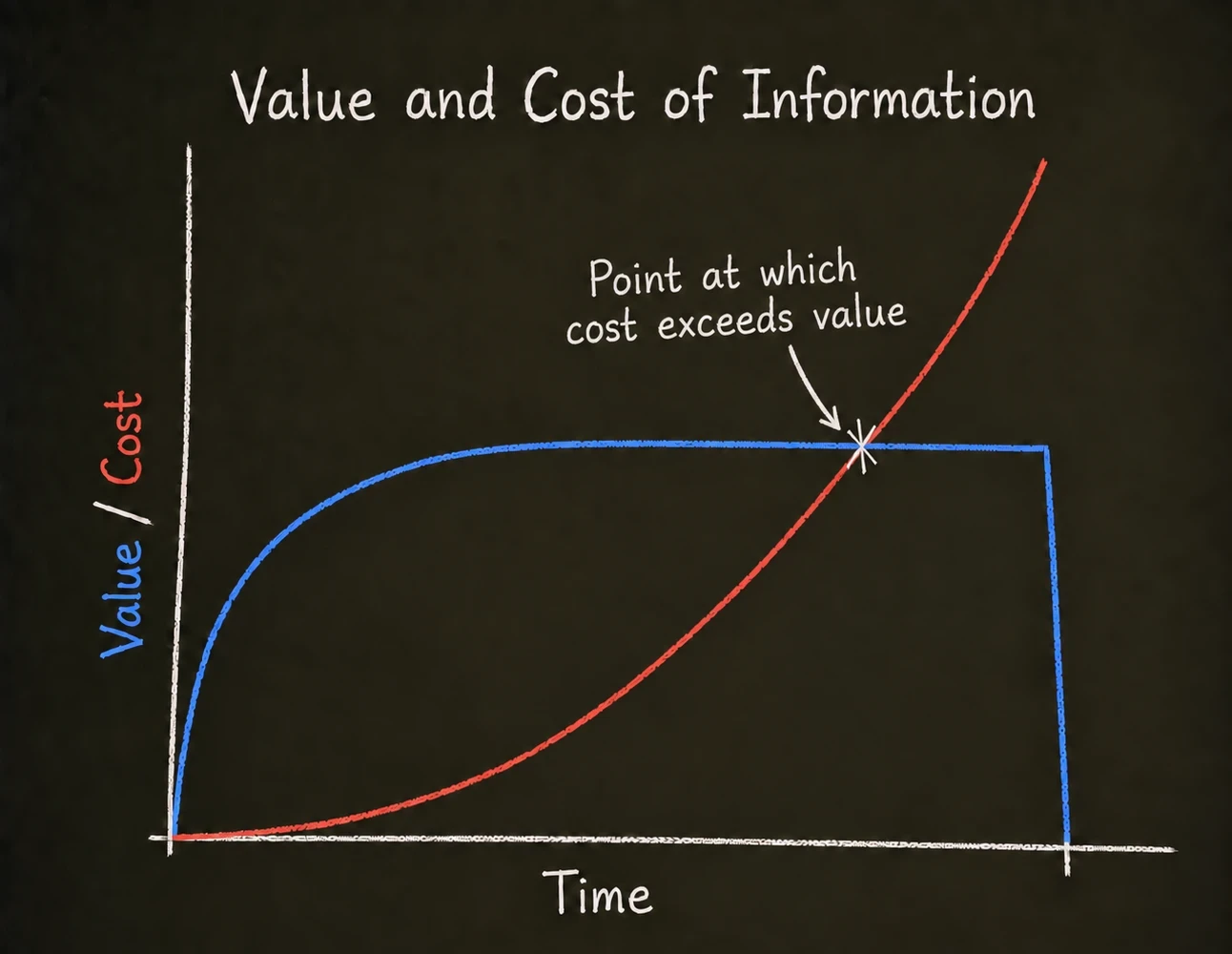
Figure 0 — Value and cost of information over time, recreated from Grace Hopper’s 1982 lecture.
Four decades on, “data is an asset” has become the standard line — and yet we treat every table in the data warehouse as an equally valuable one: same infrastructure, same quality bar, same governance, same retention.
Hopper’s question is still open. Let’s try to answer it.
1. Value lives in the decision
Since the time of Grace Hopper, several people have tried to value information from different viewpoints:
- Cost — what it took to create and maintain.
- Replacement / loss — what it would cost to reconstruct, or what disappears if it’s lost.
- Market — what a buyer would pay, where a legitimate market exists.
- Economic / use — what its use creates or protects.
Doug Laney’s book Infonomics developed these concepts the furthest for enterprises, and it remains the established foundation. But each lens answers a different question — which is a large part of why none of these measures ever became widespread practice.
Infonomics catalogues six valuation models, and two of them (PVI and EVI) gesture at this same difference-in-outcomes logic. But they start from the asset and work toward value. I find it more useful to start from the decision…
What decision becomes better because this information exists?
Decision theory gives this a formal shape:

If nothing changes (i.e., no decision, no action, no outcome), then the value of information is basically zero. This is regardless of the amount spent on acquiring and maintaining this information.
Example: A bank can spend 500,000 KWD on a beautiful customer-360 platform; if no decision changes because of it, the realised value rounds to nothing. Meanwhile a single bit arriving at the right moment — this transaction is fraudulent — can be worth a substantial loss avoided. Hopper’s example is exactly this case.
Information isn’t valuable because it exists. It is valuable because it changes a decision or an outcome — while it still can.
2. Value changes with time — but not on one curve
Hopper’s sketch had a single decaying value curve crossing a rising cost curve. For some information, that’s exactly right — a fraud signal is worth an enormous amount at its earliest.
Most enterprise information doesn’t behave this simply though. A single piece of information carries several value curves at once, and they don’t move together.
One event, three curves
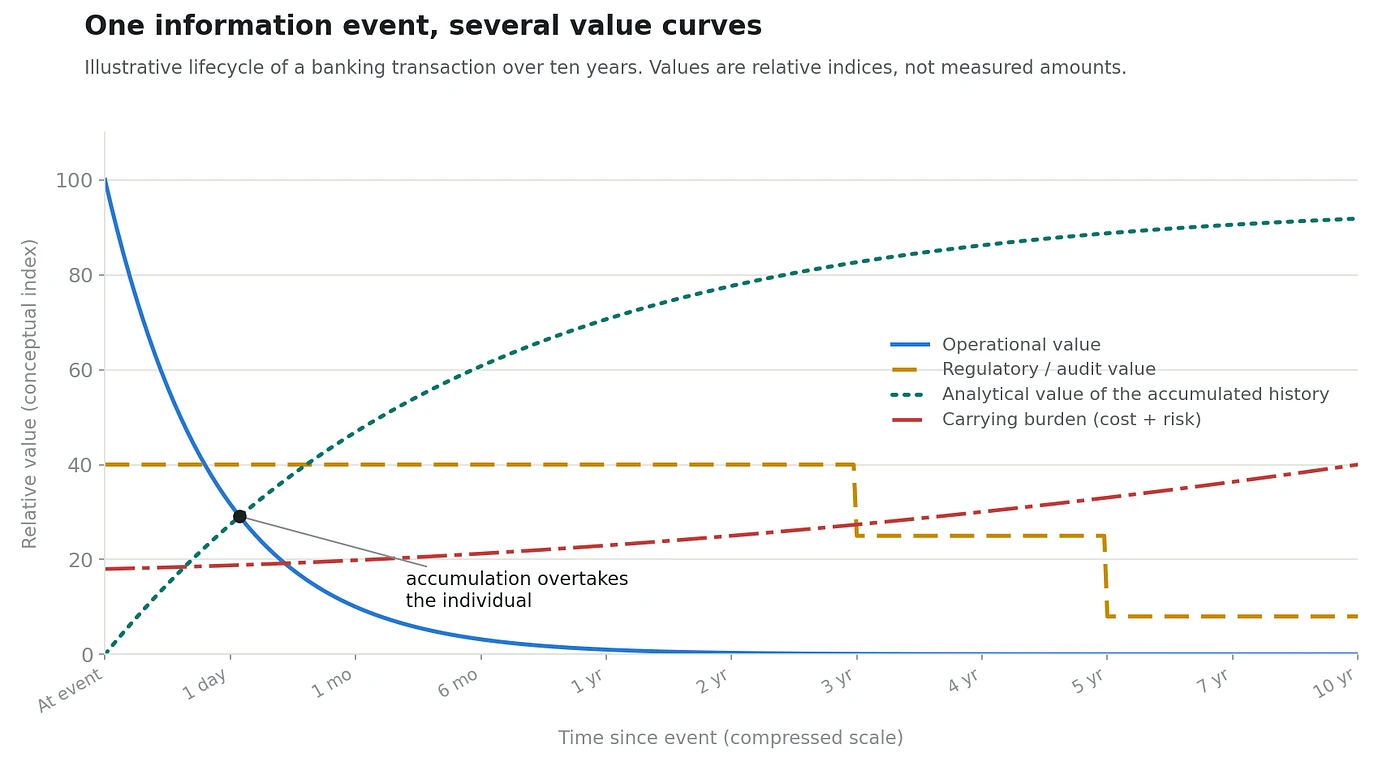
Take a customer’s salary credit arriving at 09:01 on a Tuesday.
- Operational value peaks immediately — fraud screening, salary transfer gift, etc. — then fades over the following days and weeks, as each of those decisions passes.
- Regulatory / evidential value doesn’t decay with time — but drops. The transaction is exactly as audit-relevant in year four as on day one. It holds flat as long as retention obligations require, then drops in steps as they expire.
- Analytical value moves in the opposite direction: it rises. Joined to twenty-four months of its siblings, the transaction helps answer questions no single observation could — is this income stable? Rising? Interrupted? Did the customer change employers, take a career break, start a business? Early signs of financial stress?
The analytical value belongs not to the transaction but to the accumulating history it joins. Every new transaction makes the old ones slightly more informative, because they now have more context around them.
But can old data really keep gaining value?
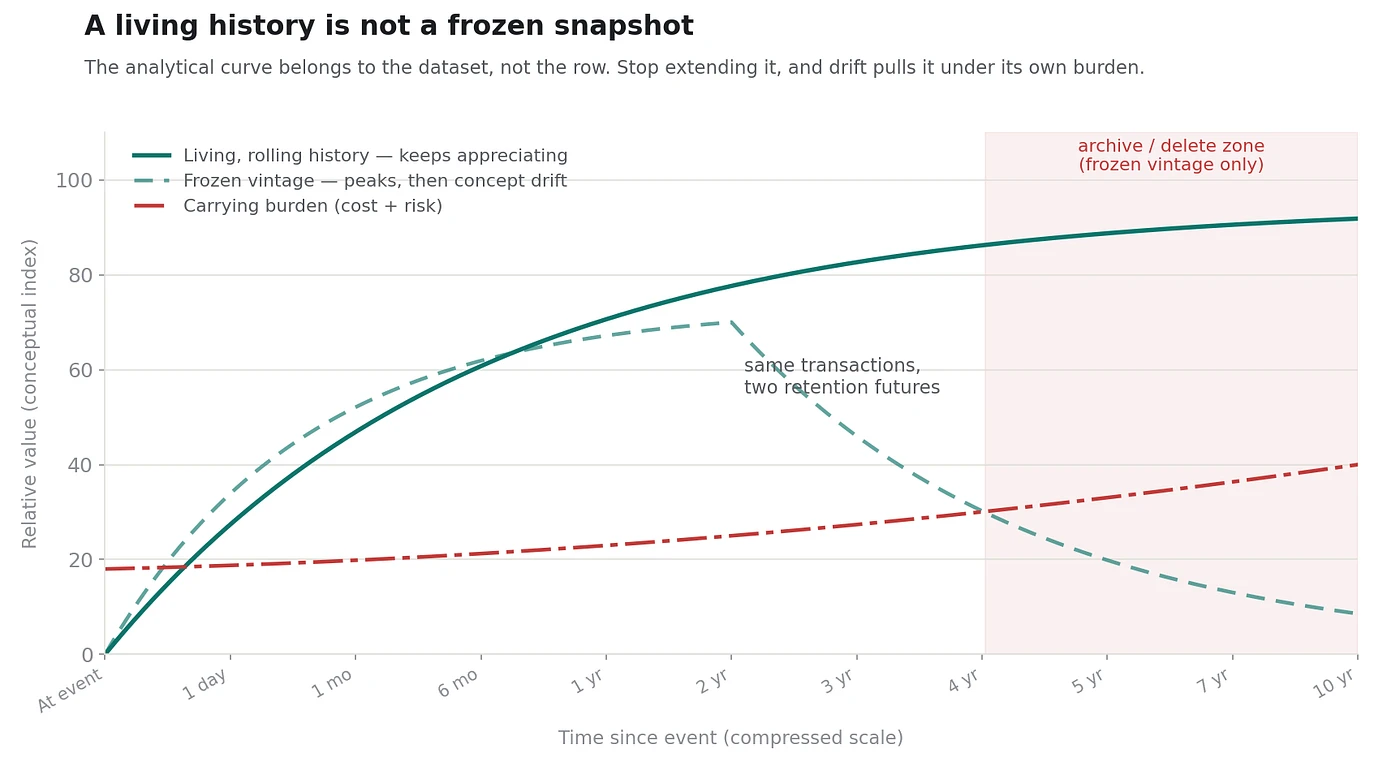
A transaction from 2018 describes a world that no longer exists — spending patterns shift, salaries change, customers leave. So the appreciation claim needs one condition attached: the dataset must keep growing. Two things that look identical in a data catalogue behave completely differently over time:
- A frozen snapshot of transactions stops growing — the 2019–2021 extract pulled for a modelling project and never extended. Excellent training material when it was cut; quietly poisonous five years later, because the world drifted away from it. Its value rises, peaks, and then decays.
- A living history of transactions is maintained as a growing panel. It never goes stale, because its most recent observation is always today (append fresh data daily).
In a living history, the old observations have a different job. They aren’t there to describe today’s customer — they supply what only depth of history can:
- trajectories which a snapshot cannot compute,
- rare events — defaults, fraud — whose scarcity, not recency, limits the models built on them,
- stress periods analysis, which no calm decade can substitute for,
- backtesting against a past that cannot be recreated once deleted.
One refinement keeps this honest:
Accumulated history appreciates only toward a ceiling determined by the decisions it serves.
For a marketing model, year eight adds almost nothing to year three. For through-the-cycle credit risk and stress testing, year eight might be the most valuable year in the set. The appreciation curve isn’t a property of the data — it’s a property of the decision portfolio the data serves.
When the burden wins
Keeping information was never free (the other side of Hopper’s picture), and the cost was never just storage. The carrying burden includes:
- the technology that serves it,
- the governance that documents it,
- the security that protects it,
- the privacy exposure it creates,
- the risk it silently accrues.
Storage gets cheaper every year. Almost everything else on that list grows as data ages and accumulates — obligations and attack surface grow with the pile. So every information asset runs a quiet race, and eventually, for most:

That crossing should trigger a decision, not drift: lower the service tier, archive, aggregate, anonymise, or delete where regulation permits.
The retention question, stated properly
Gross analytical value never falls — old history can always be ignored, so a longer panel is never analytically worse than a shorter one. But net value — gross value minus carrying burden — rises, crests, and then starts declining.
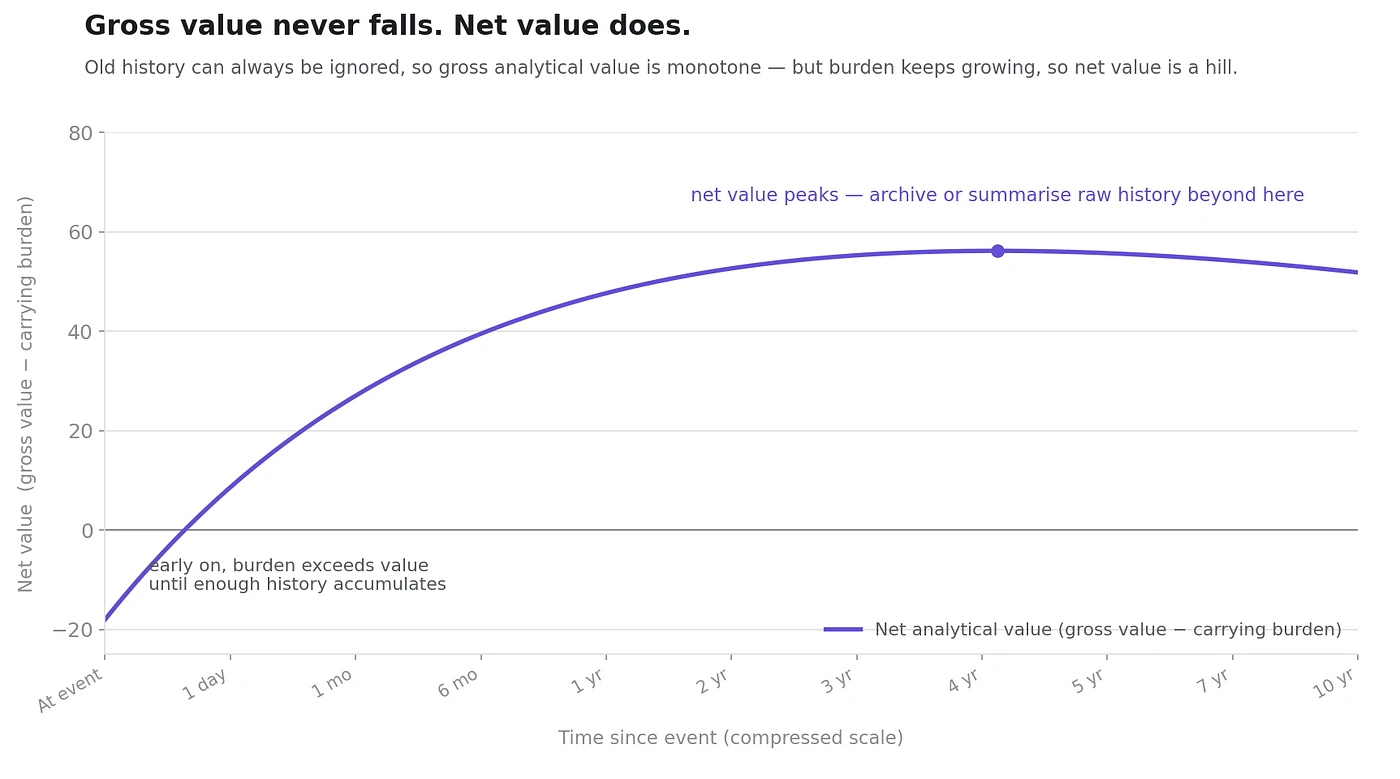
The retention question is not when value reaches zero. It is when net value peaks — because past the peak, every additional year of raw rows makes the asset worth less, even while its gross value still grows.
3. Treat information according to what it deserves
If this were only philosophical, it could wait. AI made it urgent:
- AI decreases the cost of activating information that sat dormant for years.
- Agents multiply the number and frequency of decisions a piece of information can influence.
- And wrong, stale, poorly governed information now propagates into more decisions, faster, with less human review in between.
AI increases the leverage of information — good and bad alike. Which makes valuation a practical instrument, not an accounting exercise: it tells you which information should become AI-ready first, and which should never be given that authority.
The method doesn’t need a PhD in economics. Assign value to domains, not tables, and for each major information asset:
- Identify the decisions and uses it supports.
- Estimate their economic outcomes.
- Estimate the information’s contribution — not the whole outcome.
- Adjust for quality, timeliness, and useful life.
- Add reuse and option value.
- Subtract lifecycle cost and risk.
- Triangulate against replacement / loss value as a sanity check.
Avoid false precision. The output is not a figure for the balance sheet — it’s a ranking, and a ranking is enough, because the purpose is allocation of resources. It tells you:
- which domains deserve real-time pipelines, and which deserve batch;
- where quality investment changes decisions, and where it gilds unused tables;
- which histories earn durable, analytics-ready storage even if nobody queries them today;
- when raw history should be archived or summarised;
- which information has earned the right to feed AI systems that act.
We don’t value information to learn what it’s worth. We value it to decide what it deserves — in speed, quality, governance, and investment.
Closing Thought
Hopper’s factory valve question was never really about valves. It was about priority — the recognition that treating all information equally is itself a decision, and usually a bad one.
In 1982, the question was which information deserved processing and expensive online storage. Today, it is which information deserves investment, quality, AI access, and the authority to drive decisions and actions.
The stakes have changed. The question hasn’t:
What is the value of information?
The organisations that can answer this question won’t necessarily hold more data than their competitors. They will simply use data — and AI — better: more efficiently, with stronger governance, and pointed at the decisions that matter.
If you work in data or AI and have tried to put a value — formal or informal — on an information domain, I’d genuinely like to hear how you approached it.